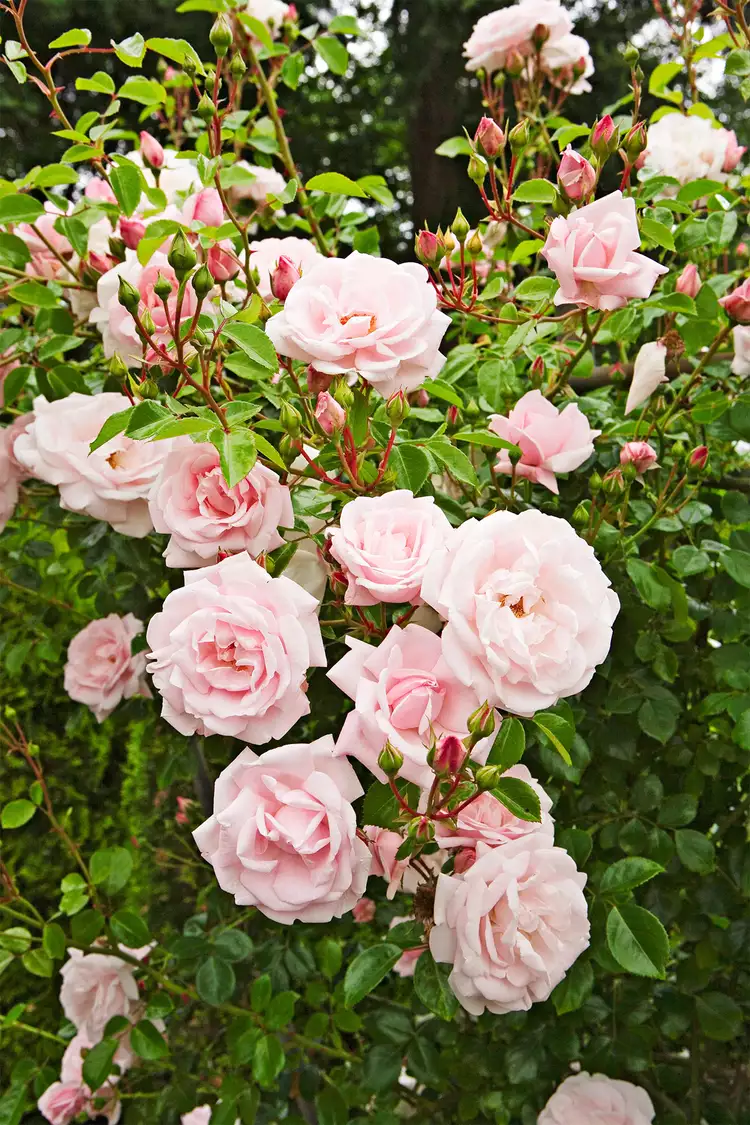
Climbing roses work their way over an arbor gate or fence or up a quaint brick facade. While these graceful flowers may seem daunting, climbing roses are easy to grow and create a cottage feel.
Climbing roses develop long canes that are well-suited for trailing on pillars, fences, arbors, and gazebos. They produce either large, single flowers or clustered blooms on a stem. Climbers can be trained to bloom more heavily by leading their canes horizontally. Anchoring them loosely to a support structure will encourage young plants to climb.
Climbing rose blooms tend to have one heavy bloom in spring and then sporadic blooms throughout the rest of the growing season. How they bloom depends on the variety planted. Regular deadheading of the flowers can encourage continuous blooming. If you decide to prune your plants in winter before the initial bloom, you can increase the number of blooms you get later. These perennials are hardy in USDA Zones 4-11.
Climbing Rose Overview
| Genus Name | Rosa |
| Common Name | Climbing Rose |
| Plant Type | Rose |
| Light | Sun |
| Height | 3 to 20 feet |
| Width | 1 to 6 feet |
| Flower Color | Blue, Orange, Pink, Red, White, Yellow |
| Foliage Color | Blue/Green |
| Season Features | Fall Bloom, Summer Bloom, Winter Interest |
| Special Features | Attracts Birds, Fragrance |
| Zones | 10, 11, 4, 5, 6, 7, 8, 9 |
| Propagation | Stem Cuttings |
| Problem Solvers | Deer Resistant, Good For Privacy |
Where to Plant Climbing Roses
Climbing roses need support, such as a trellis, arbor, pergola, or fence, and they require plenty of room to spread out and have the airflow they need to stay healthy. They don’t climb like vines and can’t support themselves, so gardeners must tie the roses to support them at several points.
Plant climbing roses where they receive full sun for most of the day. They need well-draining, rich, loamy soil. If needed, amend the soil with compost or other organic material before planting.
How and When to Plant Climbing Roses
The best way to start with climbing roses is as bare-root plants. Plant in late winter or early spring when the soil isn’t frozen or soggy from winter weather. That gives the roots time to become established before the hot summer months. Bare-root plants easily acclimate to new soil since they’re not being transplanted from other planting mediums.
Don’t wait too long to start training the rose to the support; the stems can become woody and tricky to work with. In most cases, simple ties of natural jute twine or another soft material will do the trick. If you want to train the rose up a wall or solid surface, you’ll need to attach a trellis or support system a few inches away from the wall. The rose won’t climb a hard, smooth surface without support. It also allows some space behind the plants to promote good airflow.
If the soil in the planting area isn’t well-draining, amend it with compost or well-rotted organic matter. Soak the roots of a bare-root rose in water for a couple of hours before planting. Dig a hole about 18 inches by 18 inches and form a mound of soil at the bottom of the hole. Position the rose so that the roots spread loosely over the mound. The graft should be at soil level. Backfill the hole with soil and lightly press down with your hands. Water the plant.
Climbing Rose Care Tips
Climbing roses need much of the same care as regular rose bushes do.
Light
Roses can tolerate some shade, but they do best where they get four to six hours of sun a day, producing bigger and fuller groups of flowers.
Soil and Water
Rich, loamy soil is best for roses. If your soil is lacking, enhance it with fertilizer or compost. These plants prefer moist soil with a neutral to alkaline pH. Soil should be well-draining. If the ground is clay or packed tightly, loosening it up about a foot deeper than the hole will help with drainage.
Roses need about 2 gallons of water per plant each week, but be careful not to overwater, which can cause root rot. Use a soaker hose to water—it’ll keep the leaves dry, helping your roses resist disease. Wet leaves can harbor diseases that cause foliage to fall off the plants.
Temperature and Humidity
Ideal temperatures for climbing roses are between 50ºF and 80ºF. If temperatures get above 80ºF, make sure your roses get some afternoon shade to protect them from the heat. Similarly, if temperatures dip below 32ºF, provide coverage for the plants, but don’t cover them too early in the season. Wait until the first frost.
Fertilizer
When first planting climbing roses, add compost to the soil. After the plants are established, use a balanced fertilizer every two to three weeks, following the manufacturer’s instructions. When the weather starts to cool, stop fertilizing about eight weeks before the first frost date to limit new growth that can be damaged by the cold.
Pruning
When the climbing rose is established in a year or two, you can begin regularly pruning it. Typically, you need to prune a climbing rose only once a year after the first main flush of blooms. This is a good time to address any diseased or damaged canes and make pruning cuts to improve airflow or direct future growth. Avoid pruning rose bushes in the fall since pruning stimulates new growth.
Potting and Repotting Climbing Roses
Like rose bushes, climbing roses do well when planted in a pot. The pot needs to be large, at least seven to 10 gallons, since climbing roses grow vigorously and spread up and out. Potted roses need support, just like garden roses. If the rose is a small type, support can be provided by a small trellis inserted in the pot at planting time, but if the rose is a standard size, a location adjacent to a trellis or fence is a better choice than an in-pot support to avoid a top-heavy pot.
Use a mixture of peat moss, potting soil, and mulch, and fill the pot halfway up. When planting the rose, keep the bud union (where the cane meets the roots) 2 inches from the top of the soil. Water regularly, or set up a drip irrigation system to keep the soil moist.
Pests and Problems
As with any rose, disease prevention is vital to healthy plants. In the spring, clean up any old leaf debris from previous years’ growth. Airflow and sunlight are key to preventing fungus. Roses’ main downfalls are various fungal pathogens.
Rosette disease is a serious problem that spreads locally from plant to plant, but climbing roses are also susceptible to many other pests, particularly aphids and Japanese beetles. Luckily, these garden pests are easy to treat with insecticidal soap (or pick them off and throw them in a bucket of soapy water). You can also give them a hearty blast of water to knock them off the plants.
How to Propagate Climbing Roses
Propagating climbing roses is easy and the best way to grow more roses for your garden.
To propagate a climbing rose:
- In late spring or summer, cut an 8-to-12-inch semi-ripe stem from the current year’s growth, making the cut right below a set of leaves.
- Remove any flowers and leaves except for a leaf or two at the top of the cutting.
- Prepare a small pot with a mixture of compost and perlite, and use a pencil to make a hole in the center of the planting medium.
- Dip the base of the cutting in rooting hormone and place several inches of the stem in the pot without rubbing off the rooting hormone.
- Gently firm the planting medium around the base of the cutting with your fingers and add a humidity cover such as a dome or plastic bag.
- Check the cutting periodically, keeping the planting medium moist but not wet.
- Watch for roots coming out of the drainage hole or give a leaf a gentle tug; if you feel resistance, the cutting has rooted. Once roots begin to grow, remove the humidity cover.
After about nine months, the propagated stems will be ready to plant in the ground.
Types of Climbing Rose
‘Alberic Barbier’ Climbing Rose
Rosa ‘Alberic Barbier’ was bred in 1900 and is still popular today. This charming climber offers pale yellow buds unfurling to warm ivory flowers that are double in form and scented with a green apple fragrance. Vigorous and rambling, the plant grows 15-20 feet tall and is hardy in Zones 5-9.
‘Altissimo’ Climbing Rose
Rosa ‘Altissimo’ has large single red flowers that glow like embers against the medium green foliage. It blooms repeatedly through the season. The disease-resistant plant grows vigorously 6-10 feet tall. This French-bred variety is hardy in Zones 5-9.
‘America’ Climbing Rose
Rosa ‘America’ marked the beginning of the modern climber class and won the 1976 All-America Rose Selections award. Large, pointed buds unfurl to many-petaled, coral-pink blooms that show their ‘Fragrant Cloud’ heritage. The flowers are produced in sprays and have a spicy fragrance. These upright, disease-resistant plants can be slow to start climbing. They grow 8-16 feet tall and are hardy in Zones 6-9.
‘Climbing Snowbird’ Rose
Rosa ‘Climbing Snowbird’ is a vigorous climber with a high-centered white flower. It is exceptionally fragrant. Like other white roses, it is breathtaking in evening light. Zones 7-9
‘Don Juan’ Climbing Rose
Rosa ‘Don Juan’ is an all-time favorite red-flowered climber. It’s a plush, hybrid tea-style bloom with a tart, citrusy fragrance, glossy, disease-free foliage, and reblooming vigor. The foliage color is a velvety dark green, and open flowers are cupped. It climbs 10 feet tall and 6 feet wide. Zones 5-9
‘Eden’ Climbing Rose
Rosa ‘Eden’ has huge blooms that appear profusely throughout the season. The flowers consist of up to 100 petals tinted in shades of pale pink, cream, and soft yellow. Extremely hardy, the plant lends itself well to arbors, trellises, and fences in colder climates. It climbs 10 feet tall by 6 feet wide. Zones 5-9
‘Joseph’s Coat’ Climbing Rose
Rosa ‘Joseph’s Coat’ is a dependable climber for many climates, offering cupped, semidouble blooms of yellow blended with cherry red. The plant grows 12 feet tall by 6 feet wide. Zones 5-10
‘Golden Showers’ Climbing Rose
Rosa ‘Golden Showers’ is always in bloom. The ruffled, semidouble flowers grow throughout the season with a light fragrance. Plants grow 10 feet tall and 5 feet wide. Zones 8-10
‘New Dawn’ Climbing Rose
This repeat-blooming variety features lush, petal-packed blooms of the softest pink. The sweetly fragrant flowers are clustered on long, strong stems. It grows 18 feet tall and is disease-resistant. Zones 5-9
‘Fourth of July’ Climbing Rose
Rosa ‘Fourth of July’ is an award-winning variety with semidouble, ruffled red and white striped flowers. Blooms repeat continually and yield to large orange hips in fall. It climbs 10 feet tall and 6 feet wide in milder climates but remains shrubby in colder regions. Zones 5-10
‘Sombreuil’ Climbing Rose
Rosa ‘Sombreuil’ features fully double blooms in a warm ivory peach from late spring through fall. Its fragrance is a sweet grapefruit-zest scent. The arching canes feature healthy, disease-resistant foliage. Plants grow to 10 feet tall. Zones 6-9
Climbing Rose Companion Plants
It’s hard to compete with the beauty of a climbing rose, but these companion plants are up to the task.
Foxglove
Foxglove (Digitalis) is a classic cottage garden favorite loved for its towers of blooms. This biennial thrives in full sun and partial sun locations. It dies after it blooms in its second year but not before it self-seeds prolifically, guaranteeing its future reappearance in the garden. Foxglove grows 1-5 feet tall. Zone 3-10
Delphinium
Delphinium is another cottage garden favorite prized for adding the color blue to the perennial garden. It adds a strong vertical appearance with flower spikes that grow as tall as 7 feet. Zones 3-7
Bellflower
Low-maintence bellflower is a welcome addition to a garden bed. The bell-shaped flowers sometimes appear facing upward on mats of foliage and sometimes dangle in the breeze on upright plants that grow as tall as 6 feet. The bells are another option to add blue to the garden, although bellflower is also available in other colors. Zone 3-10
Lady’s Mantle
Ever-popular lady’s mantle lends interesting texture to any landscape with its fuzzy, cup-like leaves that hold onto water droplets like little gems. Lady’s mantle features dainty yellow flowers that bloom in late spring to early summer in airy masses above the foliage. It grows up to 3 feet tall. Zone 3-7
Climbing Rose Garden Plans
Front-Yard Rose Garden Plan
Dress up your front yard (and front door) with this garden plan full of roses.